
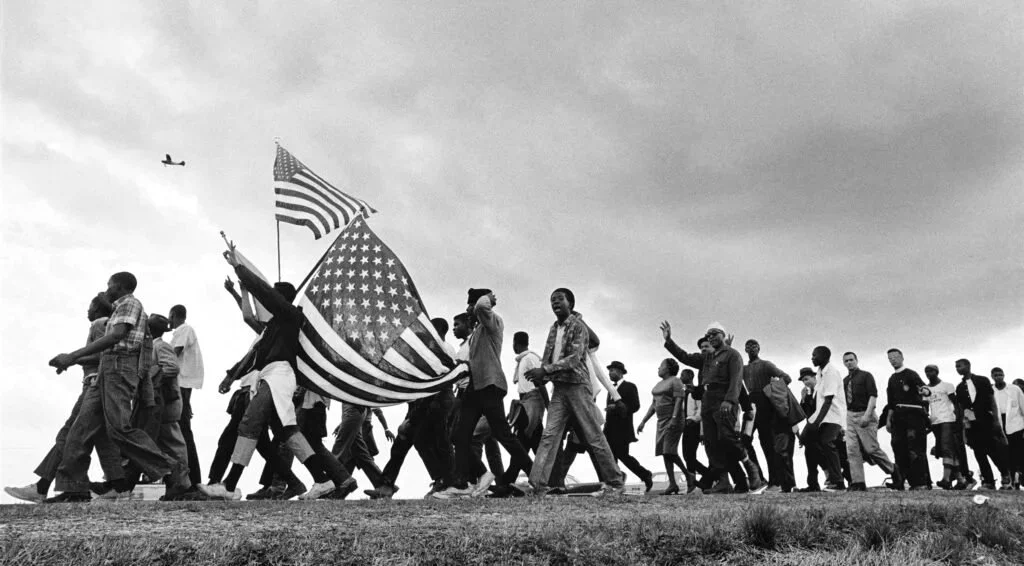
Matt Herron: A Living Archive
A community-led initiative to return Civil Rights-era photographs to the people and places that made them meaningful in the first place.
For two years in the mid-1960s, photographer Matt Herron captured some of the most iconic moments of the Civil Rights Movement.
In 1963, Herron and his wife, Jeannine, relocated their young family to Jackson, Miss., where Matt begun shooting for the likes of Life, Look, and Newsweek. Over the next two years, across Mississippi and Alabama, Matt shot incredible images of mass meetings, integration attempts, civil rights marches, and the white resistance these efforts faced. Some of Matt’s most famous images come from the 1964 Freedom Summer in Mississippi and the Voting Rights Campaign in the Black Belt of Alabama in early 1965 — notably the Selma to Montgomery March.
When Matt died in 2020, the Stanford University Libraries acquired his archive, which spanned from the late 1950s into the 2000s. Jeannine kept all the prints Matt had made over the years for exhibits about the Selma March and the broader Civil Rights Movement in Mississippi and Alabama.
Numbering in the hundreds, these prints chronicle both the iconic and the overlooked: moments of national consequence and individual courage, intimate portraits of demonstrators and sweeping scenes of collective action.
Jeannine’s hope has been that these prints might continue to live in the world, not just in institutional archives, but in the communities they depict. Her wish is that the prints are returned to the towns, schools, museums, and gathering places where the movement’s history was made, so that they can help educate and activate a new generation of young people.
So far, 200+ of the prints have been placed in institutions from Montgomery to Dayton to Richmond to Cincinnati. We have also worked with Stanford to scan hundreds of Matt’s other images from his time in Alabama, and we are now working to return these photographs to the communities where they were taken — restoring them to their original context and making them available to the families, towns, and institutions whose stories they contain.
We’ve begun this work in Marion, Ala., where we are working with community leaders and descendants to develop a long-term initiative to exhibit and interpret Matt’s photos. These images, which feature local activists who participated in the voting rights movement, had never been seen by the people of Marion — or just about anyone else — until the fall of 2025.
In collaboration with Marion stakeholders, we organized a public event in December 2025 to formally return these photos to Marion. Eventually, the photos will be part of a permanent gallery and reading space at the reconstructed Little School House site that community leaders in Marion are working to build with Auburn’s Rural Studio.
In 2026, we’ll continue to contextualize these photos with public talks, educational programs, and public exhibits around the country, starting at Foot Soldiers Park, in Selma, Ala.
For more information about the Living Archive project, contact Chip Brantley (email).